
Forty year business owner,
lead systems integrator.
I have run five businesses — a restaurant, mortgage, roofing, trucking, and now technology — and I was the person responsible for the systems in every one of them. I have signed the front of the checks, not just the back. That is why this company connects the six systems and keeps them getting better, instead of selling you one more thing to run.
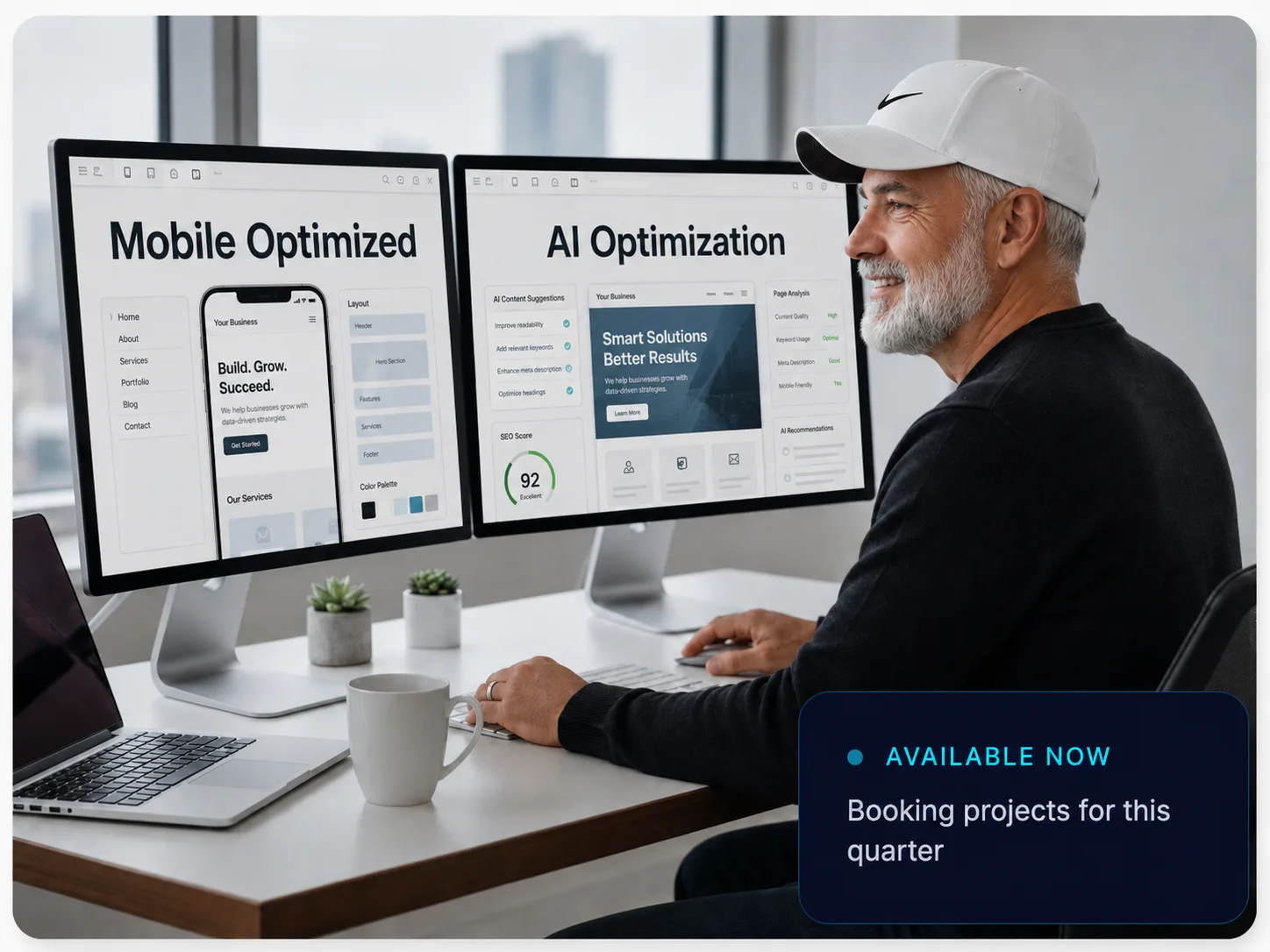
40-year operator · technologist · fractional CTO
A CTO is a Chief Technology Officer — the person who decides what software a company runs and makes all of it work together. Big companies pay one north of $200,000 a year. Fractional means part-time and shared, so a business your size can finally have one. I ran on my own from 1986 on. The whole time I had the same recurring problem: I could never find people worth the effort — people who would stick around, take the training, and actually do the job right.
A restaurant. A mortgage company. A roofing company. A trucking company I ran for twenty years. And now this one — a technology company installing AI employees, and the systems that run them.
When I did find someone good, I could not keep them long enough for it to matter. They quit. They cut corners. They went off and did their own thing. So I gave up on it and did everything myself — the work, the books, the follow-up, the ads, and yes, I was the computer guy too.
So I have sat in your exact chair, longer than most of these consultants have been alive. I know what it feels like to be great at the work and still buried under every other job in the company. I have lived it four times. Steven James Consulting does not run that way — it has a team behind the work, and the systems that finally make a team worth having. That is the difference between then and now, and it is exactly what I install for you.
Software like your Website, Customer Relationship Management software, & email never did anything without your manual input.
In 2024 that changed.
Every decade handed me a slightly better set of software tools. None of them did the work. YET...
Phone, fax, the first websites, email blasts, the customer-list software. Each one helped a little. But not one of them ever did the actual work. They sat there and waited for me to push the button. They were tools, and I was still the one holding them.
That changed for good in 2024. I could finally hire the employee I had been looking for my whole career — an AI employee. It takes the training. It does not quit. It does not go off and freelance. It does not call in sick or take days off. It answers every lead the second it comes in, follows up, books the appointment, and circles back on the cold ones. It does the job the same way every time, and I can see everything it does. That is what changed the math. The machines take the grinding, repetitive work that burned out every good person I ever hired — so a small team of people worth having can do what used to take a department. That is how this company runs, and it is what I install for you.
Almost everyone else selling AI is handing you a chatbot.
A little pop-up that answers one question and hands you back the work. That is not an employee.
And here is what they will not tell you: the raw AI brains behind all of it — ChatGPT, Gemini, Claude, Grok, whichever one you have heard of — are something anyone can rent for a few dollars a month. We work with all of them, and a big part of the job is knowing which one to put on which job.
But on its own, any of them is the smartest worker you ever met who knows nothing about your business and forgets it all by morning — brilliant, and useless to you. The hard part, the part I have spent years on, is turning that raw brain into a real employee that knows your prices, your customers, and your way of doing things — and wiring it into the six systems that run your business.
And every business runs on something different. Whatever you picked up over the years to run yours, that is your setup, and getting the AI to actually talk to it — so the two run as one machine — is the part nobody else has cracked. We do it by hand, one business at a time.
I built it for my own company first.
We built it for our own company first. Steven James Consulting runs on its own AI employees today — the exact same thing we will set up for you. I am not selling you an idea. I am selling you the thing my own company runs on.
That is why I started this technology company: to build it, set it up for you, and handle the switch so you never have to think about it.
Most people calling themselves AI consultants are reselling somebody else's gadget. We build this by hand, in real businesses. I have been doing that kind of work since 1986.
We connect the six systems your business runs on, and we keep making them better.
We build and install the AI employees on the six systems that make you money. We do not take the reins from you. We do the hard part in the background so you never have to think about it — and you keep your hand on every lead and every dollar.
You stay in charge. You are the one running it. We build the thing and keep it running, so the whole machine answers to you.
I have been the customer you are about to be.
I have hired agencies. I have been sold reports full of impressions and clicks by people who had never made a payroll and could not tell me what a customer cost me. That is why this company works the way it does.
An operator reads a profit and loss statement differently than a marketer reads a dashboard. When we talk about what a customer costs to acquire and what one is worth over the whole relationship, I am not quoting a framework — those are the numbers that decided whether I made money for forty years.
The technology is the part I enjoy. Putting AI to work on the six systems a business runs on is the most useful thing I have found in a long time, and it works because the systems get better every day without the owner lifting a finger.
The part I actually enjoy
Want to see what this would look like for your company?
Book a discovery call. Tell me how you run things today, and I will show you exactly where an AI employee fits in.
⬇️ Book A Call ⬇️
By booking, you agree that Steven James Consulting will call, text or email you to confirm your appointment, including AI-assisted calls and messages, at the number and email you provide.