
Attention To Dollars
What you know is worth money. This book shows you how to collect it. It is the blueprint, start to finish: take the attention you already have, package what you know into something people can buy, and sell it from a website you own.
Nothing is held back. Every system, every step, in the order we build it.
$495.00
Download it the minute you buy.

What you get
Five things, yours the minute you pay.
The book in two formats and the study guide in three sizes, so each one fits the screen you open it on. Every copy is a signature edition with your name on it.
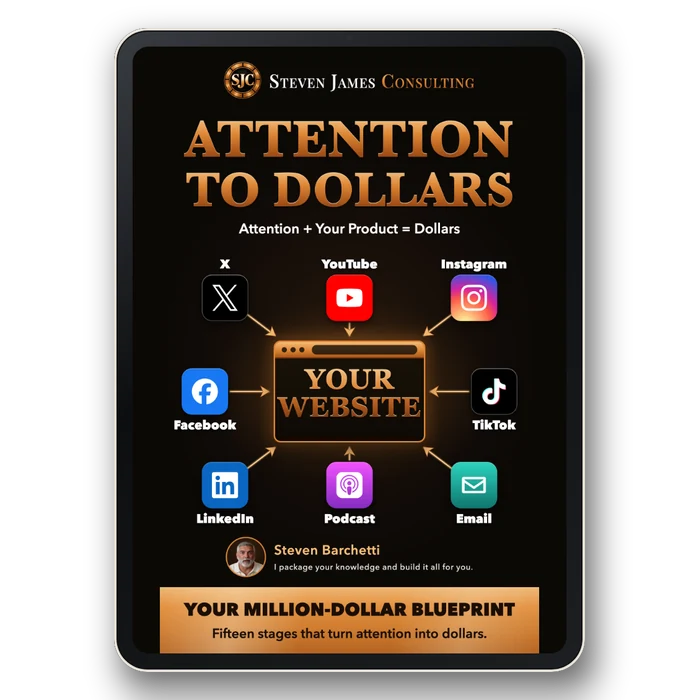
The book, for Apple Books
Opens in the Books app on an iPhone, an iPad or a Mac.
The book, for Kindle
Opens in the Kindle app or on a Kindle.
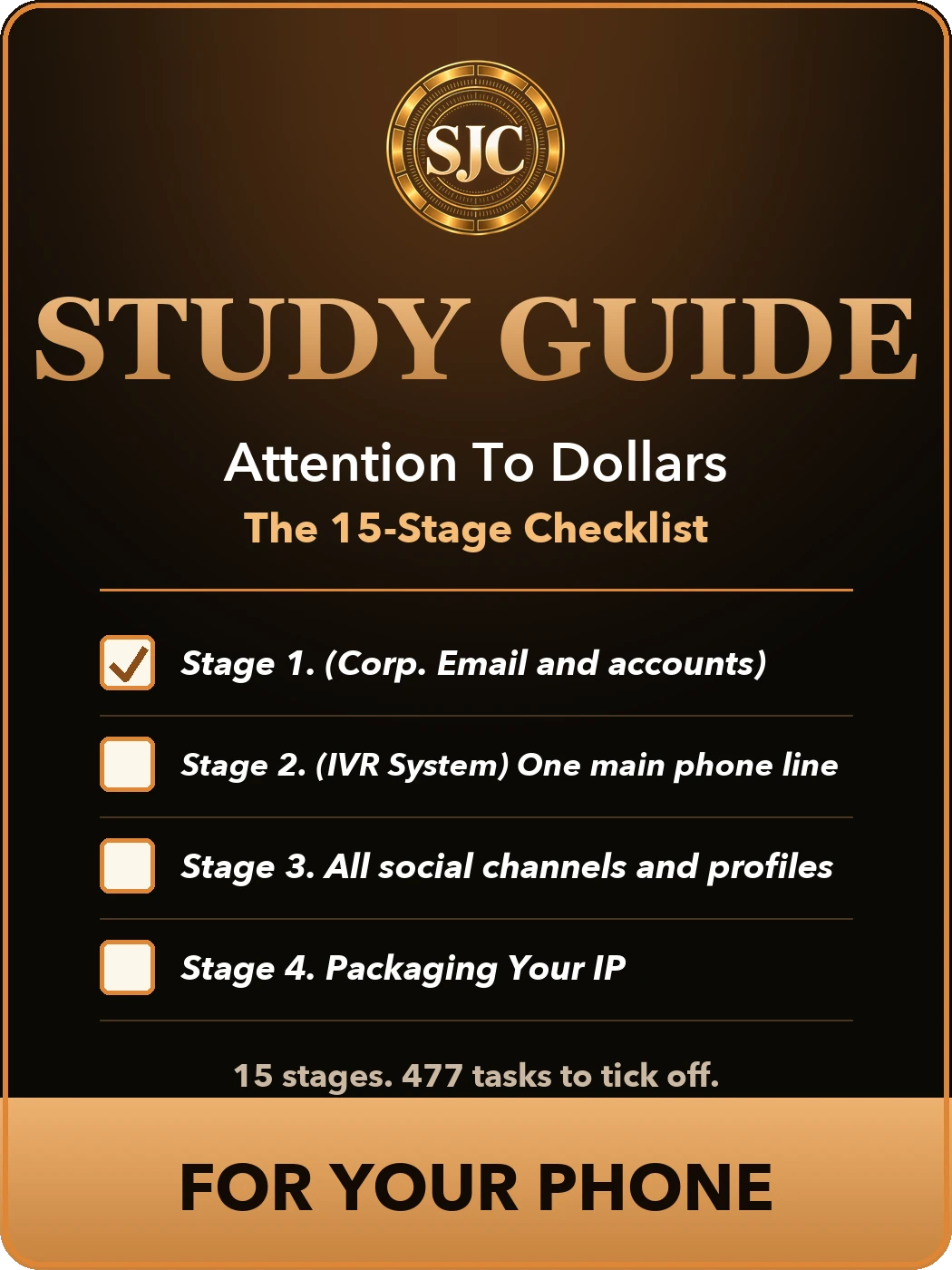
Study guide, phone size
All fifteen stages as a tick list, sized to fill a phone screen.
Study guide, tablet size
The same tick list, sized to fill a tablet.
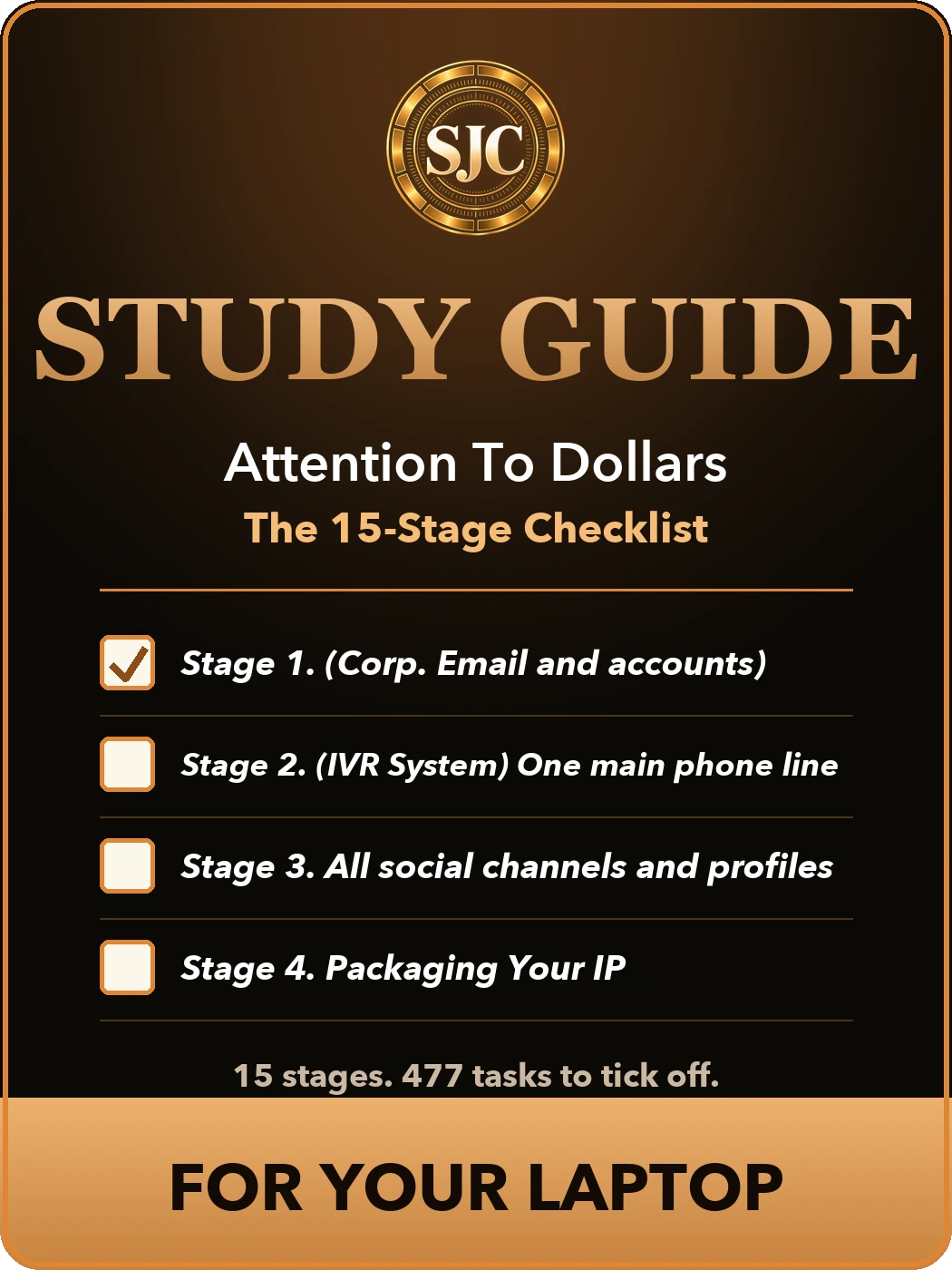
Study guide, laptop size
The same tick list, sized to fill a laptop screen.
This book was written for two people. You are probably one of them.
The spot you are in. You are a coach, an author, a speaker or an influencer. You know something other people want to learn, and you have spent years getting good at it. People watch you. Some of them quote you back to yourself. And when you look at your bank account, it does not look like your follower count. If that is you, nothing is wrong with you and nothing is wrong with what you teach. You are standing in a spot a lot of talented people are standing in, and nobody ever showed you the way out of it.
An audience, nothing to sell. The first version of that spot is a crowd with nothing to buy. You have 5,000, 10,000, maybe 50,000 followers. They like what you say. They would pay you for more of it if there were something to pay for. There is not. No program, no course, no book with your name on the cover. So the attention arrives every day and leaves every day, and all you have to show for it is a number on a screen that belongs to somebody else.
Something to sell, no hours. The second version is harder to see, because money is coming in. You have a program or a course, and it sells. But it only sells when you answer every message yourself. A person asks what it costs on a Saturday night, and you see it three days later. You make sales when you launch something, and it goes quiet in between. You could not hand me ten names and phone numbers of the people watching you. The business works exactly as hard as you do, and it stops when you stop.
The two readers. Chapter one talks to two readers in turn. One has built an audience and is missing everything that goes behind it. The other has no audience yet. I tell that second reader something they do not expect: you are not behind. You get to build the system first and open the doors after, the way a franchise is built. The first stranger who ever finds you will have a place to land, a way to leave a name and something to buy. Most people with big followings cannot say that.
Getting attention is one skill. Turning it into income is a different skill.
Not a talent problem. I want to be plain about this, because you may have been blaming yourself. Getting attention is one skill. Turning it into income is a different skill. Being very good at the first tells you nothing about the second. The people I talk to are clearly good at what they do. What is missing is the part that goes behind the audience, and that part can be written down, in order, in plain words. That is what this book is.
A blueprint is the whole plan. This one is the plan for your entire business.
The whole plan. Think about what a blueprint does for a house. It shows every room, where the doors go, what holds the roof up, and the order the work gets done in. Nobody lays a floor before the foundation. A blueprint is not a tip about windows. It is the whole plan, on paper, before anybody picks up a hammer. This book does that for your business. It is the plan for how a person who knows something gets paid for it, start to finish, in the order it gets built.
Not one tactic. You have probably bought tactics before. How to grow on one platform. How to write a caption. How to run an ad. Every one of those is a room, and some of them are good rooms. The trouble is that a room with no house around it does nothing for you. More views with nowhere to send the viewer is a good day and an empty bank account. The book never hands you a room without showing you where it sits in the house.
One line. The whole model fits in one line, and it sits under the title on the cover. Attention + Your Product = Dollars. Attention is the people watching and listening to you. Your product is what you know, packaged so a person can buy it. Dollars are what you get when you send the first to the second, on a website you own. Attention by itself does not pay you. A product by itself does not pay you either. A good course nobody hears about is a store on a road with no cars.
A good course nobody hears about is a store on a road with no cars.
Every part of it. So the blueprint covers all of it. How you get the attention, on platforms that send you no bill. How you take what is in your head and turn it into something with a name and a price. Where the sale happens, which is a website with your name in the address. And the six business systems behind that website that answer every person, follow up, ask for the review and ask for the sale. Connected, those six are one Revenue Engine. That is a business model, front to back.
From plan to house. A plan is worth what gets built from it, so this one is written to be built from. That can be you, on your own time. It can be a helper you pay, working from the chapters. What the blueprint gives you is the plan itself: what goes where, what comes first, and how to check that each piece works before you build the next one on top of it.
None of this is new. What is new is that one person can afford all of it.
An old idea. I did not invent any of this, and the book says so in its first pages. Every business I have owned ran on the same three moves. Be known. Have something worth buying. Keep showing up until the person is ready. The book goes back to a hamburger stand in the 1950s, where two brothers built a way of working that anybody could be taught to run, and to the author who later gave the idea a name: the franchise prototype. The system runs the business. People run the system.
What it used to take. Here is why that idea was never yours to use. A system like the one at that hamburger stand needed three things. It needed a building for customers to walk into. It needed a payroll, because a person had to take every order and answer every question. And it needed an advertising budget, because the only way to reach a stranger was to pay for the space. I learned that in 1986, the year I opened a restaurant. When the money stopped, the strangers stopped with it. A person whose whole business is something they know had none of the three.
Free airtime. Today you can go live on five different social media platforms and nobody sends you a bill. That is airtime, every day, for anybody holding a phone, and the book treats it that way. It has you pick one question your buyers ask, answer it on camera, and end by saying your own website address out loud. You can put out your own show. You can publish your own book and sell it from your own website, which is what I did with this one. I have watched forty years of tools arrive, and never in that time has so much been available to one person at such a low price.
The work gets done. The second change is the bigger one. Every tool I ever put to work made a person faster. The fax did not write the letter. The website did not answer the question. A human still had to do the job, which is why growing always meant hiring. An AI employee is the first tool in forty years that does the work. It reads the message, writes back, and books a time on your calendar, at 11:40 on a Saturday night. That is what took the payroll out of the plan.
So why not you. If you are truly an expert at what you do, there should be no reason you are not making money from it today. I mean that kindly. The stages cost nothing and the staff is no longer a payroll. That leaves two jobs, and the book is laid out around them. Getting your attention and your product to meet is the work of Part Two and Part Three. Telling the world is chapter seven. Plenty of very good people are waiting to be discovered. Nobody is coming to discover you. That job is yours now.
If you are truly an expert at what you do, there should be no reason you are not making money from it today.
The plain word. There is a plain word for telling the world, and I use it in the book. Self-promotion. People cannot buy from somebody they have never heard of. For most of my working life that meant buying an ad. Today it means showing up and teaching what you know, where people are already watching, with every clip pointing home to the website you own. It does not matter what you do for a living. You have to do it. The book shows you how to do it on a schedule, so it does not eat your week.
Your part. Here is the honest split. Getting good at what you teach took you years. Call it your ten thousand hours. No book can hand them to you, and that is what makes them worth so much. A talent agent stands behind real talent. He does not manufacture it. You have already put those hours in, or you are putting them in now. The blueprint is everything else. Where the attention goes, what you sell, how it gets sold, and who does the work while you sleep. You bring the reps. The book brings the rest.
It is $495.00 because it is the whole blueprint.
You build this once and you use it for the rest of your life. Look at what you have today. Your followers live on platforms somebody else owns, and you could not hand me a list of their names. Follow the blueprint and you have a website with your name on it, a list of real people who raised their hand, and six systems that answer them, follow up and ask for the sale. Your website, your list, your systems: they keep working for as long as you are in business.
The blueprint is laid out in the order my team and I build, in plain words. It is the same method clients pay my team to build for them. Every system gets its own chapter, and no chapter ends until you have proved the thing works, on your own phone, the way a stranger would meet it. You are not paying for a description of a business. You are paying for the working drawings: what to open, what to write, what to connect, and how to know you are finished. Build from it yourself, or hand the book to somebody you pay and have them follow it.
None of the pieces in here is new, and that is good news for you, because none of it is an experiment. Every one of them has been around for years. What you are paying for is the order and the tests. Which system goes in first, and why. What each one needs from the one before it. How you prove a piece works before you build the next one on top of it. That is what forty years of building systems taught me, and it is the part I see people get wrong when they build from scattered advice. Read it, and you will know how a business like yours gets built, start to finish.
The blueprint shows you our proprietary Revenue Engine. The build puts it to work for you.
Same engine. The engine in the book is the engine my team builds for clients. There is one. We call it the Revenue Engine, and it is how my own company runs. There are three roads to it. Do it yourself is the book. You do the work, or somebody you pay does. Done with you is the Revenue Share Partnership. My team and I do the building, and you are in it with us. Done for you is my team doing all of it. The parts are the same, the order is the same, and the tests at the end are the same. The whole thing comes down to one line: Attention + Your Product = Dollars. Here is what each of those three words means on every road.
Attention. Facebook, Instagram, TikTok and YouTube are free stages, and a podcast costs next to nothing once it is set up. Most people show up on them with no plan for where the viewer goes next. The book starts by having you draw a map: every place people find you around the outside, your website in the middle, and every arrow pointing one way, toward the website. Your first job in the book is to point every profile you have at that one address. On a done for you build, my team sets up every one of your pages to do the same thing.
Your Product. A crowd with nothing to buy stays a crowd. You already know something people want to learn, and most of you have never put it in a form a stranger can buy. The book has a chapter on exactly that: taking what you know and packaging it into something with a name and a price. On a done for you build we do the packaging with you. That starts with your own e-book, made the way this one was, with your name on the cover, sold on your website. Then your own podcast, produced by our team, living on that same website.
Dollars. A person rarely pays the first time they come across you. It takes seven to ten times. The Revenue Engine is six business systems that keep you in front of a person until they are ready: Premium Smart Websites, the Automated Organic Content Engine, Speed to Lead, Automated Five Star Reviews, CRM Mastery, and Paid Ads = Booked Appointments, added last. Together they sort, sift and funnel your audience from a follower to a paying client. The book gives each system its own chapter. On the build, my team connects all six and has them running.
AI employees. This is the part that once took a hired staff. AI employees do that work now, at any hour. They answer the messages, follow up with the people who went quiet, and ask every client for a review without anybody having to remember. The book shows you how to put them to work yourself, including one taught to speak for you in your own words. I call that one your AI twin. On a done for you build, my team sets them up, teaches them how you talk, and reads their conversations so they keep getting better.
A talent agency. My company is a modern day talent agency, and a talent agent does three things for the talent. A talent agent teaches you self-promotion, packages what you know, and shows you how to sell it with a modern website and a sales system. That sales system is the Revenue Engine. On a build, my team does those three things for you. In the book, I hand you the agent's own notes. Chapter seven is the self-promotion. Chapter two is the packaging. The rest of Part Two is the website and the sales system. You become your own agent, with my notes open beside you.
You become your own agent, with my notes open beside you.
The only difference. Who does the hours, and what comes with it. With the book, the hours are yours or your helper's. You open the accounts, follow the steps and run the tests. With the build, the hours are ours. My team builds every system, writes and produces your e-book with you, produces your podcast, and then keeps it running every month. You get a US company with a team behind the work, and you get me on your account. You get a copy of my business, front to back, with your name on it.
What is the same. What you end up with. A website that sells for you at any hour. A list of people who raised their hand, that you can reach whenever you have something new. What you know, turned into a product with a name and a price. That is what you have if you build it from the book on a Saturday. It is what you have if your assistant builds it from the book. And it is what you have if my team builds it. The social platforms stay what they always were, free stages you use on purpose. Every one of them now sends people to the place where you get paid.
Why we sell all three. Because talent does not arrive with the same bank balance, and I did not want to leave anybody behind. Some of you have more time than money right now. That is a stage, not a verdict. So I wrote the whole plan down. That is do it yourself. The blueprint is $495.00, and you build at your own pace. The people who build it themselves understand it best. Some of you have real talent and cannot write the full check today. That is done with you. The Revenue Share Partnership is $3,995.00 to start, and my team and I do the building with you in it beside us. And some of you are ready now. That is done for you, $40,000.00 to $60,000.00, and my team builds all of it and keeps it running. Three doors. One Revenue Engine.
Three parts. Read it once, then build from it.
Sixteen chapters in plain words. No tech background needed.
Part One: Why
None of this existed. Free airtime on every platform, AI employees in place of a hired staff, and the map: every arrow points to the one website you own.
Part Two: Build It
The six systems, one chapter each: what to rent, what it costs, the steps in order, and how you know it is working. Then your AI twin.
Part Three: Run It
How the six connect into one Revenue Engine, what your week looks like once it runs, and the numbers to watch.
What is in the book, and what you will be able to do when you finish it.
Written for a stranger. I wrote this for somebody who has never seen a system like this, because most people have not. None of it is new. Nobody ever explained it to you. So there are no engineer words, and nothing assumes you know what came before. Every build chapter is laid out the same way, so you always know where you are: what this system does for you, what you need before you start, what you rent and what it costs, the steps, how you know it is working, what to do the first week, and the mistakes that waste money.
Part One, the why. You learn why a following by itself does not pay you, and what rented land means. I tell you what happened to my own book when I put it on somebody else's property. Then you get the map. By the end of Part One you can draw your own map on a single sheet of paper, see which arrows are missing, and point every profile you have at one address. That alone is a job many people with a big following have never done, and you can do it before you spend a dollar on anything else.
Packaging what you know. Before you build anything, you need something to sell. One chapter walks you through taking what is in your head and turning it into a product a stranger can understand and buy. Who it is for. What it does for them. What you call it. If you already sell a program, a course or a book, this chapter sharpens it. If you have an audience and nothing to offer them yet, this is the chapter that ends that. After it you can say what you sell in a sentence, and that sentence goes on your website.
Own and rent. One chapter comes before the building, and it saves you the most money. It lists what you own and what you rent, names the job each rented account does, and gives you the monthly total for the whole thing on one page. It also gives you the build order, and the reason ads go last. You see the whole build laid out before you start, the way a builder reads the plans before the first delivery arrives. When you finish this chapter you know your real monthly number and you know exactly what you are building first.
The website. The first system, and the one every other system plugs into. The chapter takes you through the page a follower lands on: your story, what you sell, the proof, and a way to book a call or buy right there. You learn what has to be on it and what does not belong. You finish with a test you run on your own phone, as if you were a stranger who just tapped the link in your profile. After this chapter your followers finally have somewhere to go, and you own the ground they are standing on.
The content engine. This is how you show up every day without it eating your life. You sit down once and record what you teach. That one recording becomes the week's videos, clips and episodes on every platform you are on, and every one of them points back to your website. The chapter gives you the setup you do once and the weekly recipe you repeat. After it, you know exactly what you record, what gets cut from it, where it goes out, and how to tell whether people are coming to your website from it.
Speed to Lead. When a person comments, sends a message or fills in a form, they are interested right now. A day later they have moved on. This chapter shows you how to put an AI employee on every door so each person gets an answer in seconds, day or night, in your words, and gets offered a time on your calendar. After it, buyers get an answer while they are still interested, and you stop being the person who has to answer every message yourself for a sale to happen.
Reviews and old names. Two chapters, two of the easiest wins. The first makes sure every client, student and reader gets asked for a review, every time, with nobody remembering, so the next buyer sees proof. The second goes back to the names you already have: everyone who followed, bought once or asked a question and went quiet. It tells you what the first message says and how the replies get worked. That is where the cross-sells and upsells live. Easiest money you'll ever make, because you already earned that attention once.
Paid ads, last. Ads get their own chapter and it comes at the end on purpose. An ad sends more people into whatever is behind it. If what is behind it leaks, you pay to lose people faster. So you build the rest first. The chapter shows you how to add advertising once the free attention is turning into buyers, what to watch, and when to turn the ads off. After it, you can tell the difference between an ad that is buying you booked calls and one that is only buying you views.
Your AI twin. Your followers want more of you, and there is one of you. For a long time the only fix was hiring people. Now an AI employee can speak for you. The chapter shows you how to teach it what you sell, who it is for, the questions people ask you every week, and the way you talk. It also shows you how to practise with it before it ever talks to a stranger. After it, a person can ask a question on your website at two in the morning and get an answer that sounds like you.
Part Three, run it. Six systems that do not talk to each other are six chores. Part Three connects them into one Revenue Engine. You follow one person from the first clip they see to the day they pay, and you check every hand-off on the way. Then you get your week. A long list of work the engine does without you, and a short list that is your part: take the calls, record, approve what goes out, and read what your twin said. And you get four numbers to write down once a week, each one pointing at the system to fix.
When you close the book you can explain the whole model to your spouse at the kitchen table.
What you can do. When you close the book you can explain the whole model to your spouse at the kitchen table. You can draw the map from memory. You can build it yourself in order, or hand a chapter to a helper and know what must be true when the job is done. You can look at your own business and see which piece to build next, and why it goes there. And if you decide to have my team build it, you already know every piece we will be putting to work for you.
If you already know you want the whole plan in your hands, it is one tap away.
Part One is the why. Here is what is in the introduction and the first four chapters.
Sixteen chapters. Counting the introduction, the book has sixteen chapters in three parts. Part One is the why. It is short, and the build makes no sense without it. Part Two is the build, one system at a time. Part Three connects the systems and shows you how to run them. Here they are in order, under the titles printed in the book: what each one covers, what you will understand after it that you did not before, and what you will have built or decided by its last page.
The introduction. None Of This Existed. It starts in 1986 and walks through forty years of tools as I lived them: the phone and the fax, the first websites, email, the software that keeps a list of names, social media. Each one made a person faster and not one did the work. Then you meet the one that does. You get the formula, the hamburger stand, the six systems by name, and the rule that organises everything after it: you own some things and you rent others. You finish it understanding why growing always meant hiring, and why it no longer has to.
Chapter 1. Two Readers, One Map. This chapter sorts you. If you have an audience, it gives you a list of signs that the back half is missing, and you will recognise your own week in it. If you have none yet, it tells you why the same map works for you and why you should not skip ahead to the videos. Both readers get the same five-part list, which is the order of the book. Then you fill in one sheet of paper: your platforms and followers, the names you already hold, what you sell, what one sale brings you, and who helps you. That sheet is your before picture.
Chapter 2. You Have Something To Sell: Package It. It opens with the sentence I hear most: I don't know what to sell. My answer is that you have a talent, and it looks ordinary to you because it is easy for you. You learn what packaging means: a name, a beginning and an end, a result, and a price. You meet the four boxes a skill goes in: a book, a course, a program, a talk. Then ten steps take you from talking it through out loud to saying one price to ten people who could buy. You end with one sentence that goes on your website word for word.
My answer is that you have a talent, and it looks ordinary to you because it is easy for you.
Chapter 3. Rented Land, And What Happened To My Own Book. You see the picture most people are living in: social pages around the edge and an empty box in the middle. Then I show you the terms the big online bookstores offered me for this very book, and why I walked away. The lesson is older than the internet. Whoever owns the shelf sets the price and keeps the customer. You also get the four questions I ask before I rent any place to put my work, and one rented place that passes them. After this chapter you can tell good renting from bad.
Chapter 4. The Map. The same picture, with one box added in the middle and every arrow pointing in. It is the map I have been drawing since 2008. You learn the three jobs of that middle box, in order: capture the name, book the call, make the sale. You check your own map on your phone in five minutes. Then comes your first build task, and it costs nothing: one name, one photo, one line and one address on every profile you keep, and no door on your website leading back out. You finish with your map drawn and your missing arrows listed.
Part Two is the build. Eight chapters, one system at a time, in the order that matters.
Chapter 5. Before You Build: What You Own, What You Rent, What It Costs. This is the whole build on one page, read before you open a single account. It lists the four things you own. It lists every account you rent and the one job each of them does, in plain words. It gives you the monthly totals, so you know your number before you start. It gives you the build order and the reason ads go last. And it gives you the rule the whole book runs on: every system gets tested before the next one is built on top of it. You finish it having decided who does the work.
Chapter 6. Build System One: The Website You Own. You are not building a ten-page website. You are building one page that tells your story and does three jobs. Nine steps, each ending with a line that says when it is done. You buy your address. You write the page before anybody designs it. It gets built for a phone first. Then the form, the calendar, the checkout, being found in a search, connecting your real address, and pointing every profile at it. The test is five checks on your own phone, ending with a real card buying your product. Five for five, and your followers have somewhere to go.
Chapter 7. Build System Two: The Content Engine. This is the self-promotion chapter, and it is where you use the free airtime. You set it up once. Then comes a weekly recipe: pick one question your buyers ask, record ten minutes in one take, and have that recording cut into the week's clips and written pieces, each one ending with your address. You get the four-part shape of a good answer, how each platform treats a link, and an honest count of what one recording really gives you. Nothing goes out without your yes. The reader starting from zero gets a section of their own.
Chapter 8. Build System Three: Speed to Lead. It opens at 11:40 on a Saturday night, with a woman who has just finished your book and wants to know what your program costs. From what I have seen, the one who answers first usually gets the sale. Here you put an AI employee on that shift. The most important hour is writing its training document: what you sell, the prices it may say, the ten questions you hear most. Then a second list of what it must never do, including guess, promise a result, or pretend to be a person. The test is nine checks from a friend's phone.
Chapter 9. Build System Four: Five Star Reviews, Every Time. Before a stranger pays you, they look you up. They are not asking whether you are the best. They are asking whether it is safe. Your videos are you saying you are good. A review is somebody else saying it. This chapter builds the asking so nobody has to remember. It checks in first, while the work is still going, so an unhappy student becomes a phone call the same day. You put it right. Then everybody gets invited, at the moment of the win. Two asks, never three. And the reviews come home to your own website, beside your calendar.
Chapter 10. Build System Five: The Names You Already Have. There is money you already earned sitting in a place you never look. Everybody who bought once, signed up for something, or asked a question you meant to answer. You gather every name into one list you own, take out the doubles, and mark where each one came from. Then you write a first message that is a question, with no link, no price and no offer. It goes out in small daily groups, and every reply gets worked until it ends as a booked call or a polite no. This is where the cross-sells and upsells live, and it is the easiest money you'll ever make.
There is money you already earned sitting in a place you never look.
Chapter 11. Build System Six, Last: Paid Ads. Paid ads work, and the chapter says so first. They go last because an ad does not fix what is behind it. It sends more people into it. You do not advertise the grand opening until the kitchen can serve the line. Before any money moves, you write down two numbers: what one buyer is worth to you over time, and the most you will pay to win one. Every ad sends people to the website and the systems you have already tested. And you decide when to turn the ads off before you spend the first dollar, while your head is clear.
Chapter 12. Your AI Twin. Show up every day and people write back, and there is one of you. Your twin is the AI employee from chapter eight, taught more of you and put to work in more places: on your website, and in the comments and messages where people try to reach you. It has one job, which is to bring people home and book the call. The sale and the teaching stay with you, and the twin's work is getting the right people onto your calendar. You write its question sheet and its price lines yourself. Then you play the difficult buyer on a private practice page before a stranger ever meets it.
Part Three is where six systems become one business that runs whether or not you are in the room.
Chapter 13. Connect The Six: Your Franchise Prototype. Most people who have all six pieces still watch money disappear. It goes where a system is missing, or where two systems are not connected. You follow one person from the first clip they see to the day they hear from you again months later. Then you get a checklist of nine hand-offs, each with what must pass and how to check it. One rule covers the whole list: a connection you have never seen work is not built. You run it with your own name and your own phone, once for every door a person can come through.
Chapter 14. The Week: What You Do, What The Engine Does. Two lists. A long one of the work that now happens at any hour with nobody remembering. A short one that is your part: take the calls, record, approve, and read what your twin said so you can teach it. Then four numbers you write down once a week, on the same day: hands raised, the slowest answer, booked calls, and cost per buyer. Likes are not on the list. Each number points at the system to fix. The chapter ends with a test. Take a week off from everything but your booked calls, and see what stopped.
Take a week off from everything but your booked calls, and see what stopped.
Chapter 15. Do It Yourself, Or Have It Built. By now you hold the whole thing, and this chapter is about who does the building. It gives you three ways, and all three are fine with me. Build it yourself, in order, passing each test before you open the next chapter. Hand it to somebody you pay, with three rules that get you a finished job. Or have my team build it, and the chapter tells you what that involves and who it suits. It also tells you what you end up with on any road: a website, a list, your words and a product, all working together to bring in buyers.
What you hold at the end. Add it up. A map you can draw from memory. A product you can say in one sentence. A page that takes a name, books a call and makes a sale. A week of clips from one recording. An AI employee on the midnight shift. Reviews that get asked for without you. An old list that has been worked. A way to buy attention as a decision and not a gamble. A twin that talks the way you talk. And four numbers that tell you where to look. That is a business model, written down in the order you build it.
Read it once. Then build from it, one chapter at a time.
Read it through first. Read it start to finish before you open a single account. The systems lean on each other, and you will make better decisions in chapter six when you already know what chapter ten is going to need from it. Part One you can read in a chair. Part Two reads differently the second time, when it is open beside you and you are doing the steps. The book is written to be read first and worked from second.
Why the layout matters. Every build chapter is laid out the same way, and here is what that does for you in the middle of one. You never wonder whether you missed something. The list of what you need comes before the steps, so you do not get halfway and stall. Many steps end with a line that begins "Done when", and it describes something you can see with your own eyes. And every chapter closes with the mistakes that waste money, so you read about them before you pay for them.
In order. Build in the order the chapters come. I am firm about this in the book and I am firm about it here. Speed to Lead has nothing to answer until the website can take a name. Ads sent to a page that cannot catch anybody are money you will not see again. The content engine comes second, right after the website, and the plan says why. It costs almost nothing, and the habit of recording begins in your first week, as soon as there is a page to point at. Attention takes months, and every week you wait is airtime you did not use.
Attention takes months, and every week you wait is airtime you did not use.
The test. One rule from my own build sheet runs through the whole book. A thing that has never been tested is not built. A form that says thank you and saves nothing looks finished. So every build chapter ends with a test you run yourself, on a phone, the way a stranger would. Leave a name and find the row on your list. Book a call and find it on your calendar. Buy the product and find the money. You do not open the next chapter until the test passes.
Do it yourself. Some steps only you can do, and the book marks them. Opening the accounts. Writing your story. Writing what your AI employee may and may not say. Recording yourself. For much of the rest, the book shows you how to describe what you want in plain sentences to an AI building assistant, which writes the files for you. You never have to read what it wrote. You check the result, and every chapter tells you how. In places the book gives you the sentence to type, word for word.
Or hand over a chapter. If you have an assistant or somebody on your team who is good with a computer, the book is your written order. Hand them the chapter and the "Done when" line, and pay for the result on that line, not for hours. They work from the same steps you read, and you run the test at the end to see the finished piece working. The book marks which steps most readers hand to a builder, and it tells you what kind of person to look for.
Keep it open. You do not finish this book and put it away. It sits on your phone or your tablet while the work is going on. You will come back to the sheet from chapter one, the sentence from chapter two and the map from chapter four. Months from now, when one of your four numbers drops, chapter fourteen will send you to the system that needs fixing. A blueprint stays on the job until the job is done, and after that it stays for the repairs.
You will not find this book on Amazon. That is the point.
A store would cap what we can charge for it at $200.00, keep most of that, and keep your name. Read that last part twice. When a store sells a book, the store knows who bought it and the author does not. He never gets the name or the email, so he can never speak to his own reader again. So we sell it on the website we own, and the only thing we rent is the card processor. We know who our readers are, the same way you should know yours.
Musicians and actors have been handing most of their money to the company in the middle for as long as there has been a middle. The label owned the record. The studio owned the film. The talent did the work and got what was left. That is the old kind of talent business. Ours is the modern day kind, and in it the talent owns the website, the list and the product. Social media was never free either: the advertising paid for it, and you were what was sold. Every hour you spend building a following there, you are building on somebody else's property. They can change the rules or shut your account off tomorrow, and your audience goes with it.
This book shows you how to turn that around. Use the free platforms on purpose, and send the attention to the place you own. You still show up on Facebook, Instagram, TikTok and YouTube, because that is where people are and it costs you nothing. The difference is that every video, clip and episode now has one job, which is to send a person to your website. That is where they leave a name, where they can buy, and where nobody stands between you and them. Buying this book on our website is that idea at work, with you on the other side of it.
When you have followed it, here is what you have working for you, and what it takes to keep it running.
Four things. The book comes back to one short list again and again. You own four things: your website, your list, your words and your product. You set the price on those four. They sell while you sleep. They grow every week you show up. Everything else in the plan is a tool, and a tool is rented. You rent the best one for each job, and when a better one comes along you put it to work for the same four.
Your website. One address on the internet with your name in it. One page that tells your story, takes a name, books a call and makes the sale, built for the phone your visitor is holding. Every profile you run points at it, and nothing on it points back out. It is the address you say out loud at the end of every video, and it is open for business every hour of the day, including the ones you are asleep for.
One page that tells your story, takes a name, books a call and makes the sale, built for the phone your visitor is holding.
Your list. Today you have followers, and you could not email one of them. When you have followed the blueprint you have the names, emails and mobile numbers of people who raised a hand, in a place you own, with a note on each row of where they came from and where they stand. A follower is a number on somebody else's screen. A name on your list is a person you can reach any time you want, whatever any platform does next.
Your product and your words. What you know, with a name, a beginning and an end, a result and a price, sold on your own page, so you know who bought. And your words: every recording, every clip, every page, every answer you wrote down for your twin. Those words are what your AI employees work from. The longer you run the engine, the more of you is on paper. Most experts carry all of that around in their heads and never put it anywhere.
Your systems. Six of them, connected, tested by you, running together as one Revenue Engine. Clips going out every day from one recording. An AI employee set up to answer at any hour. A follow-up that goes out when somebody goes quiet. A review asked for at the moment of the win. An old list worked a few names at a time. Ads, when you choose, sending buyers into a system that is ready for them. And a twin that brings people home.
What it costs to run. Chapter five lays this out on one page. You rent a short list of tools, one for each job, from the company that does that job best. The chapter gives you the monthly totals for all of them together, so you know your number on day one. It names the job each tool does, in plain words, so you know what every dollar is doing for you. It also says this: a lot of people I talk to pay more each month for one piece of software that does one job.
Built to last. Where the book names a tool, it is naming today's tool. The tool will change. The job will not. When a better tool comes along you put it to work, and your website, your list, your words and your product keep right on selling. That is why the blueprint is written around the jobs and not the gadgets. It is the same three questions I have asked for forty years, and it will still be useful to you years from now. I wrote it that way on purpose.
Your website, your list, your words and your product start with the blueprint.
Forty years, five businesses, and one job I had in every one of them.
Since 1986. I opened a restaurant in 1986. After that came mortgage, then roofing, then a trucking company, and now technology. Five businesses over forty years. They had very little in common except the job I ended up with in every one. Somebody had to work out how the phone got answered, how a customer got followed up with, and how the work got done the same way twice. I was the person who built the systems.
Three questions. That gave me forty years of putting new tools to work as they arrived, one decade after another. It also gave me the way of thinking this whole book is built on. I ask three questions, in the same order, every time. What is the job? What are the fewest steps that get it done? What is the best tool for each step? Not one of them asks what is new. So I do not chase gadgets, and the book will not send you chasing them either.
We run on it. My company runs on what is in this book. We built ours first. The website you are on is system one. My twin is on the home page, and you can talk to it right now. The application is live. And you are reading a page that sells my own book from my own website, which is chapter three and chapter six doing their jobs. Everything I am describing is running right here, in front of you.
My team and I. Steven James Consulting is a US company with a team behind the work, and I stay on every account. This is the work coaches, authors and influencers pay my team and me to do, written down in the order we do it. The cautions in the chapters came off my own build sheet. The lists of mistakes that waste money are there because it costs you less to read about one than to make it.
What to call myself. For a long time I could not tell you in one sentence what all of that makes me. Somebody would ask what I do for a living and get a long answer. I only recently worked out what to call myself. I am a modern day talent agent. Nobody gave me the title. Lay the chapters of this book side by side and they describe one job: standing behind somebody who is good at something until the public knows it and pays for it. That is a talent agent's work. I had been doing it for years before I had the name for it.
A talent agent's first job is to look at somebody and see what the public would pay for, often before that person sees it.
Why I wrote it down. A talent agent's first job is to look at somebody and see what the public would pay for, often before that person sees it. You are standing too close to what you know to see it clearly. Chapter two has you do that job for yourself. The rest of the book is the other half of the work: the self-promotion, the packaging, and the website and sales system that sells it. I don't see anybody else putting all of that in one place. So I did.
Who should read the book, and who should have my team build it.
Two good roads. The right choice gets you there faster. A book reader with hours to spend gets the whole business for the price of the blueprint. A person whose hours are worth more on camera gets my team doing the building while they keep selling. So here is how I would sort it if you were sitting across the table from me. Find yourself in one of the next few paragraphs and you will know which button at the bottom of this page is yours.
The builder. Read the book if you have more time than money right now, and you like knowing how a thing works before you trust it. Plenty of talented people are at that stage, and I did not want to leave them behind. You are willing to open the accounts, follow the steps in order, and run the test at the end of each chapter before you start the next one. You do not need a technical background. You need patience and a phone to test on. If that sounds like you, the blueprint is the whole plan written down, and $495.00 puts it in your hands.
The delegator. Read the book if you have an assistant or a team member who is good with a computer. A lot of readers finish the steps and think, I understand this, and I am not the one who should be doing it. Then the book is your written order. Hand over the chapter. They build, one chapter at a time, in the order the book sets. You write the parts only you can write, like what you sell and the questions your buyers ask. And you run the tests yourself, on your own phone, as the stranger.
The reader who will hire. Read the book if you already know you will have this built for you. You are about to put real money to work. The book lets you do it knowing what each system does, what finished looks like, and what it is there to earn. You will come to the call with your map drawn and your product in one sentence. I would sooner talk to a buyer who has read it. That call goes faster, and we spend it on your business.
Have it built. Have my team build it if you are a coach, an author or an influencer who already sells what you know, and you have a small team in place. You have an audience. You have a program, a course or a book that people already buy. What you do not have is hours. Every message, every sale and every client lands on your phone. Your time is worth more on camera and on calls with buyers than it is opening accounts and connecting systems. That is the person the done for you build exists for.
Your time is worth more on camera and on calls with buyers than it is opening accounts and connecting systems.
What we do. What a modern day talent agent does. My team and I build all six systems on a website you own. We take what you know and turn it into your own e-book, made the way this one was, with your name on the cover, sold on your website. We produce your own podcast and put it on that website too. We put your AI employees to work, and connect everything so it runs as one Revenue Engine. Then we keep it running. You get a copy of my business, front to back, with your name on it, and me on your account.
What you do. Done for you does not mean you disappear. Two jobs cannot be handed to anybody. You record, because the engine can cut, caption and send out what you say, but it cannot make up what you know. And you take the calls, because a call with a buyer on your calendar is the reason the engine exists. Everything in between is ours. If you have read the chapter on the week, you already know how short your list is and how long the engine's list is.
The filter. This goes for all three roads. The model puts you on camera and puts a product with your name on it in front of your audience. That is the whole idea. If having your own podcast and your own product scares you, we are not the right fit, and the book will not change that. It will ask the same things of you that we would. If the thought of it makes you lean forward instead, keep reading, because the only question left is who does the building.
Still not sure. Then start with the book. By the last chapter you will know which reader you are, because that chapter lays out the same choice in more detail than I have room for here. Everything in it carries over if you apply later. You will know what we are building and why, you will have your map drawn, and you may already have every profile pointing at one address. We work with 5 to 10 clients at a time, so I would sooner you came to the application sure than came early.
If you saw yourself in the paragraph about having it built, apply and we will talk.
What readers ask me before they buy, and what I tell them.
I am not technical. Neither is the reader I wrote it for. Where a technical word appears, its meaning is attached in the next breath. You never have to read code. For much of the building you describe what you want in plain sentences, and the book gives you the words. It marks the few steps most readers hand to a builder, and it tells you what kind of person to hire and what must be true when they finish. Your part is the writing, the deciding and the testing. If you can use your phone and follow a list, you can do your part.
I have no product yet. Then chapter two is your chapter, and it comes before any building for that reason. You need the sheet from chapter one, a phone that records your voice, and an afternoon. You talk through how you do what you do, turn the recording into a list of steps, pick one box to put it in, name it and price it. The book tells you to sell the first simple version before you polish it. If you have an audience and nothing to offer them, this is where that ends.
My following is small. The book was written for you as much as for the person with 50,000 followers. You build the middle first, so nobody you ever reach has nowhere to go. Then the content engine builds the attention, week after week, on stages that cost you nothing. Attention builds over months, and every week you show up adds to it. And here is the advantage you have. When five messages a month is all you get, every one of them matters, and the plan is built so each one gets an answer.
How long to read. It is a book, not an encyclopedia, and Part One is short on purpose. You can read that part in a chair, and by the end of it your map is drawn. Building goes one chapter at a time. Every build chapter has its own first-week list, so you always know what this week's work is. One step waits on the phone carriers, which is why the book has you send that paperwork in early. And attention takes months, which is why the recording starts in your first week. Each chapter you finish is a piece of your business that is working.
Each chapter you finish is a piece of your business that is working.
What I need to start. Less than you think. A phone. A laptop for the building. One email address you will still have in ten years. A sheet of paper for chapter one. An afternoon for chapter two. One hour a week that belongs to recording and nothing else. You do not need a studio. The book says it plainly: nobody is buying your lighting. And you do not open every account on day one. Each chapter tells you which ones it needs.
Why a book is $495.00. Because of what is in it. Most books teach one idea, and they are priced like one idea. This one is the plan for an entire business, with every system in it. Set it beside what you have already paid for tactics that each covered one room of the house. Set it beside a month of some piece of software that does one job. And notice who set the price. I did, on my own website, which is the lesson of chapter three in practice. A plan you can use for the rest of your working life is worth a real number.
I would rather have it built. Then say so. That is what my team and I are for. The book is the plan. The build is my team doing the work: all six systems, your own e-book and your own podcast, built and then kept running. You get a copy of my business, front to back, with your name on it and me on your account. All three ways sit side by side at the bottom of this page. Every client starts with a discovery call, and you get your exact price on that call. If you want it built and cannot write that check today, read the Revenue Share Partnership page. I would still tell you to read the blueprint first. The person who knows the plan makes a better decision about who builds it.
What I walk away with. Every system, in order, with a test for each one. You walk away knowing what you sell, where it is sold, and how a follower becomes a buyer. And you find out early how much people want what you know, because the book has you say your price out loud to ten people who could buy before you build anything behind it. The rest is the part only you bring: what you teach, how good you are at it, and showing up to record every week.
Please do not buy this book if any of these is you.
Still working it out. If you are still finding out what you teach, wait. That is no comment on your talent. Everybody has something, and chapter two will help you put a box around it. But packaging needs something to package. If you have not yet done the thing enough times to explain it to a friend across a table, go and do it more. Put in your hours. The book will be here, and it will be worth far more to you then.
Not willing to be seen. The whole model puts your face on camera and your name on a product. There is no version of it where you stay hidden. The book asks you to record every week, to say your website address out loud, and to ask people to pay you. If having your own podcast and your own product scares you, this is not the right fit, and I would sooner you kept your money. If the thought makes you lean forward, that is a different story.
Looking for one trick. If you want a way to get more views by Friday, this is the wrong book. It will tell you that a like pays nobody. It builds the plain middle first: a page, a list, an answer, a follow-up. The attention comes once there is something to catch it. People who want the trick find that order frustrating. People who want a business find it a relief.
The attention comes once there is something to catch it.
Will not run the tests. This blueprint is only as good as your willingness to check the work. Every chapter asks you to pick up a phone and be the stranger. If you know you will skip that and take somebody's word that it works, you will end up with a form that says thank you and saves nothing. That is true whether you build it or a helper does. Reading it is not building it.
Here is what I would do if I were sitting where you are.
Get the blueprint. If you saw yourself anywhere on this page, get the book. It is $495.00, right here on this website. You download it right away and read it in Apple Books or Kindle on whatever you are holding. Start at the introduction and do not skip Part One. It is short, and everything you build later stands on it.
Do the first three things. Before you spend another dollar on anything, do what the first four chapters ask. Fill in the sheet in chapter one, so you have your before picture. Write the one sentence in chapter two, so you can say what you sell. Draw your map in chapter four and point every profile you keep at one address. None of that needs a new account. When you have done those three, you will see your own business more clearly than you do today.
If you want it built. Some of you already know you are not going to build this yourself. Good. That is what my team and I are for. We are a modern day talent agency. The blueprint is do it yourself, the first of three doors. The other two, done with you and done for you, put my team behind you. Each of those gets the same build: the website you own, your own e-book, your own podcast, our proprietary Revenue Engine and the AI employees that run it. The only question is which check you can write today.
The stages cost nothing. The staff is no longer a payroll.
Point everything home. You have spent years getting good at something. That was the hard part, and it is yours. The stages cost nothing. The staff is no longer a payroll. The plan is written down. What is left is to connect the dots and let the world know you exist. The three ways to get it done are right below. Whichever one you choose, point everything home.
The blueprint is $495.00, and the study guide comes with it. You download both the minute you pay.
One Revenue Engine. Three ways to make it yours.
There are three doors: do it yourself, done with you and done for you. Which one is yours depends on where you are today with time and money. Being short on one of them is a stage, and I did not want to leave anybody behind. Every door opens onto the same Revenue Engine.
The Blueprint
$495.00
For the person with more time than money right now. My book, Attention To Dollars, is the whole plan in plain words, in the order my team and I build it. You build it yourself, one chapter at a time. The people who build it with their own hands understand it better than anybody.
Get The BookRevenue Share Partnership
$3,995.00 to start
For the person with real talent who cannot write the full check today. My team and I do the building, and you are in it with us: your website, your own e-book, your own podcast and all six systems of the Revenue Engine. We pick two or three members of our community a month.
See How The Partnership WorksThe Full Build
$40,000.00 to $60,000.00
For the person who is ready to have it built now. My team builds all of it and keeps it running: the website you own, your own e-book, your own podcast and all six systems of the Revenue Engine. Every client starts with a discovery call, and you get your exact price there.
Apply For A Discovery Call